Picture this. You run a small design studio in Austin. A client in Manchester just approved your invoice for $10,000. Nice. You send the wire instructions, they initiate the transfer, and a week later you check your account.
$9,420 landed.
You call the bank. They shrug. Some combination of "FX spread," "correspondent fees," and "intermediary charges." Nobody itemizes it. Nobody apologizes. You just lost almost six hundred bucks to a system nobody at either bank can fully explain to you.
If this sounds familiar, you're not alone. And if you think it's just the cost of doing international business, that's exactly what the banks want you to think.
Here's the truth: that 3-7% you're losing on every cross-border deal isn't a law of physics. It's a tax on using payment infrastructure that was designed in the 1970s and never really got upgraded. The technology to fix it has existed for a few years now, it's being used by millions of people and businesses around the world, and it's quietly reshaping how money moves across borders.
Let's break down what's actually happening to your money — and what a better system looks like.
The Anatomy of a Cross-Border Loss
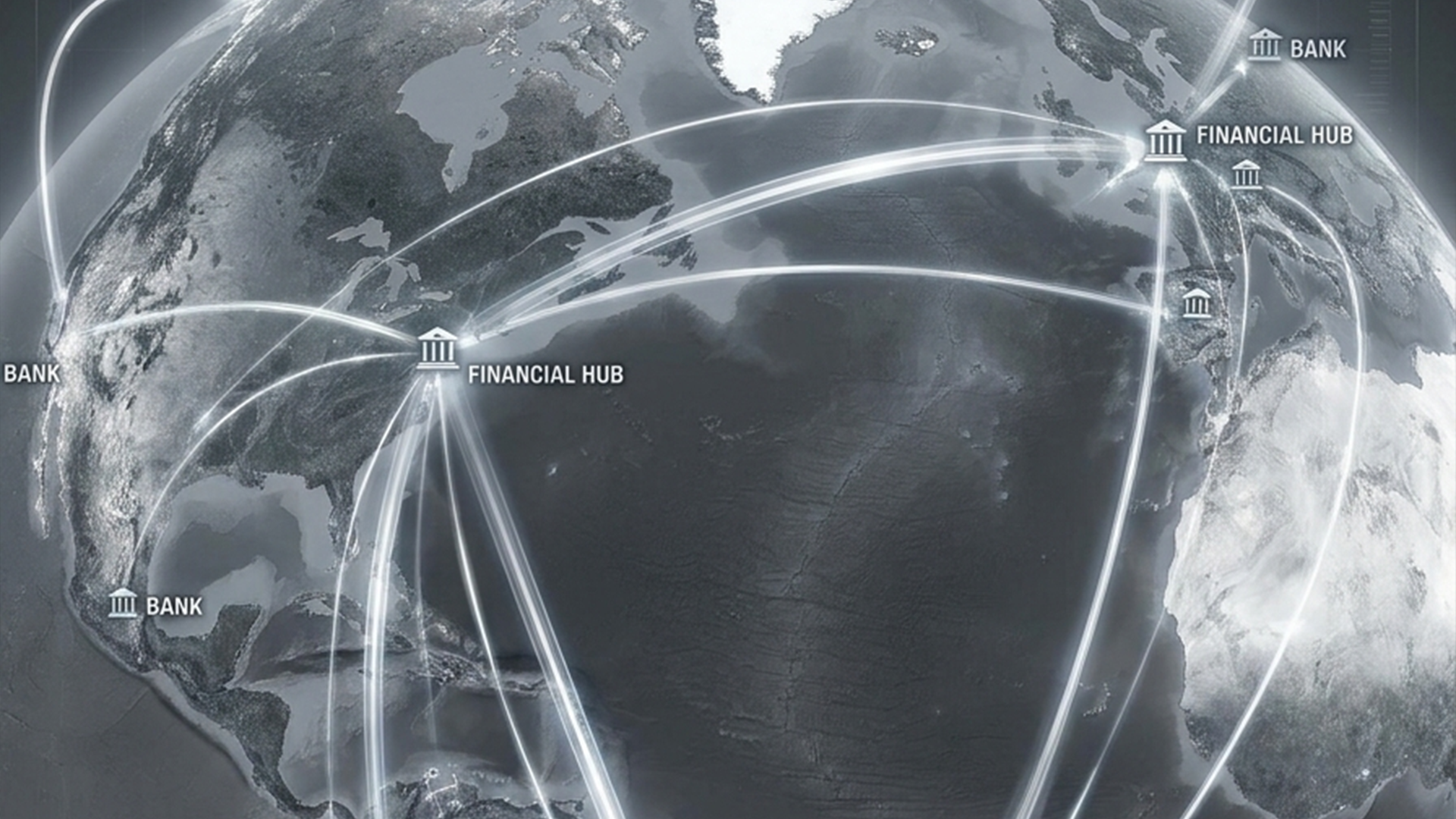
When you send $10,000 from the US to the UK via a standard wire transfer, the money doesn't just teleport. It takes a multi-hop journey through a system called correspondent banking, and each hop costs you.
Here's roughly what happens:
Your bank charges you a sending fee — usually $25-50 for an international wire. Fine, that's visible on your receipt. But then your bank doesn't actually have a direct relationship with your client's bank in Manchester. So it routes the money through one or more correspondent banks — big intermediary banks that have relationships with both sides. Each correspondent bank takes a cut, usually $15-30, and sometimes they don't even tell you. It just gets deducted from the amount that arrives. This is called a "lifting fee," and it's exactly as shady as it sounds.
Then there's the big one: the FX spread. When you send USD and your recipient gets GBP, someone has to convert it. The bank doesn't use the real market exchange rate — the one you see on Google. They use their own rate, which is marked up by 2-4% on average for retail customers. On a $10,000 transfer, that's $200-400 quietly skimmed off the top, and it never shows up as a "fee" anywhere.
Finally, the receiving bank in the UK might charge an incoming wire fee of £5-20.
Add it all up and your $10,000 often arrives as somewhere between $9,300 and $9,700. You lost 3-7% to a system that took 3-5 business days to move data that could physically travel around the world in milliseconds.
Now imagine this is happening every month. Every supplier payment. Every client invoice. Every cross-border deal. Over a year, a business doing $500K in international volume is easily bleeding $15,000-$35,000 into the gap between banks.
Why Does This Even Exist?
It's worth understanding the "why" here, because it's not just banks being greedy (though that's part of it). The real reason is more boring: the global banking system runs on infrastructure built half a century ago.
SWIFT, the network banks use to coordinate international transfers, was launched in 1973. It's not actually a payment network — it's a messaging system. Banks send each other messages saying "hey, move this money on behalf of this customer," and then the actual movement of funds happens through a web of Nostro/Vostro accounts — pre-funded accounts that banks hold at each other. To send money to a country your bank doesn't directly operate in, you have to route through a chain of banks that do, each one settling the transaction in their own books.
Every hop takes time. Every hop takes a cut. And every hop requires someone to have pre-funded dollars sitting in an account somewhere, doing nothing, waiting for transactions like yours to flow through.
The whole system assumes that money moves slowly, that business happens during banking hours, and that the only people doing international transfers are big corporations who can absorb the friction. None of that is true anymore — but the infrastructure hasn't caught up.
Enter Stablecoins
Here's where things get interesting. Over the past few years, a new kind of digital dollar has emerged called a stablecoin. The two big ones are USDC (issued by Circle) and USDT (issued by Tether). Each one is designed to be worth exactly $1. Not "roughly a dollar" — exactly a dollar. They're backed 1:1 by real US dollars and US Treasury bonds held in regulated financial institutions, and you can redeem them for real dollars at any time.
Now, I know what you might be thinking: "Isn't this crypto? Isn't crypto super volatile and scary?"
Fair question, and here's the honest answer: stablecoins are technically built on the same underlying technology as Bitcoin and other cryptocurrencies (blockchains), but they're designed specifically NOT to be volatile. They're not an investment. They're a better pipe for moving dollars. Think of the blockchain as the internet for money — it's just a more modern set of rails.
Why does this matter for your business? Because when you send a stablecoin from Austin to Manchester:
- It arrives in seconds, not days. Literally 2-30 seconds depending on which blockchain you use.
- It costs cents, not tens of dollars. A transfer on the Solana network costs less than a penny. On Ethereum's Layer 2 networks, usually under 50 cents.
- It works 24/7/365. No bank holidays. No "initiated after 4 PM cutoff so it'll process Monday." No weekends off.
- There's no correspondent banking chain taking cuts along the way. The money goes directly from sender to recipient.
- There's no hidden FX spread, because $1 of USDC is always $1. The conversion to local currency only happens at the very end, and modern off-ramp services offer rates within 0.1-0.5% of the actual market rate — not 2-4%.
Your $10,000 sent as USDC arrives as $10,000. The recipient then converts to local currency at near-market rates when they cash out. Total cost: often under 1%. Sometimes under 0.2%.
This Isn't Theory — It's Already Happening
If stablecoins sound too good to be true, here's the thing: millions of people and businesses are already using them. You just might not have noticed yet.
In Latin America, stablecoins have quietly become a lifeline. In Argentina, where annual inflation has repeatedly topped 100%, people hold USDC to protect their savings from the collapsing peso. In Mexico, workers receive remittances from US-based relatives in stablecoins that settle in minutes through platforms connected to the SPEI banking system, versus 2-3 days and higher fees through Western Union.
In Africa, freelancers and gig workers on platforms like Scale.ai and Upwork are increasingly paid in stablecoins through services like Airtm, because traditional banking in countries like Nigeria, Kenya, or Ghana involves huge fees, long delays, and currency controls. Receiving digital dollars and converting locally only when needed has become the default.
In Southeast Asia, Filipino overseas workers send money home in stablecoins because the fees are a fraction of what Western Union or MoneyGram charge. The World Bank estimates that global remittance fees average around 6%. Stablecoin-based remittances routinely hit under 1%.
For SMBs, companies are quietly moving supplier payments to stablecoin rails. A US-based importer paying a supplier in Vietnam can settle in seconds instead of days, and keep 3-5% of the invoice value that would've otherwise evaporated into the banking chain.
Even the big guys are catching on. Stripe bought a stablecoin infrastructure company called Bridge in 2025 for over $1 billion. Visa is now issuing cards backed by stablecoin balances. This is no longer fringe technology — it's becoming the backbone of how money will move internationally.
The Same $10,000, Two Different Worlds
Let's go back to our original example. You invoiced $10,000 to your client in Manchester. Here's what that looks like on both rails.
Traditional bank wire: Your client initiates the transfer on Monday afternoon. Their bank's cutoff was 3 PM, so it processes Tuesday morning. It flows through a London correspondent bank, which takes $25 and holds it overnight. Then to a New York correspondent bank, which takes another $20. Your bank receives it Thursday morning and credits your account Friday after clearing. Your client sent $10,000 worth of pounds at their bank's FX rate, which was 2.8% worse than the market rate. After all the fees and the spread, $9,455 lands in your account on Friday — four business days after the client pressed send. You lost $545.
Stablecoin rail: Your client converts their £7,800 to USDC through their regulated payments provider at a 0.3% spread. They send 10,000 USDC directly to your wallet. It arrives in 15 seconds. You convert it to USD through your off-ramp provider at another 0.3% spread, and ACH it to your bank account the same day. You receive $9,940. Total time: same business day. Total cost: $60.
Same transaction. Same amount. One system takes four days and costs you $545. The other takes a few minutes and costs you $60.
That's not a small improvement. That's a different era of infrastructure.
What This Unlocks
It's easy to look at "saving 3-7% on transactions" and think of it as just a cost optimization. But the real story is bigger than that.
When the cost of moving money internationally drops from "meaningful chunk of the deal" to "rounding error," entire new kinds of business become possible. Small freelancers can take on clients anywhere in the world without losing a week's pay to wire fees. Small businesses can source from suppliers in countries they would've written off as too expensive to deal with. Workers in emerging economies can earn dignified wages in stable currency instead of watching their local money lose value before they can spend it.
Remittances — the money that migrant workers send home to their families — become a tool for lifting people out of poverty instead of a system that extracts 6% of every dollar sent to the people who can least afford it.
Cross-border trade stops being the exclusive domain of companies big enough to have in-house treasury teams and becomes something any business can participate in.
This is what's actually at stake. It's not "crypto replacing banks." It's a fundamentally better set of rails for moving value across borders, built for how the world actually works in 2026 — where a designer in Austin, a client in Manchester, a supplier in Vietnam, and a contractor in Buenos Aires all need to do business together on the same day, in real time, without losing a fortune to middlemen.
Where Barter Comes In
At Barter, we built our platform on exactly this insight: that the infrastructure for moving value across borders is finally ready to match the reality of how people and businesses actually want to work together.
Barter lets you trade goods, services, and value with anyone in the world, with settlement handled on modern stablecoin rails. Whether you're a consultant in Toronto, a shop owner in Mexico City, or a software freelancer in Lagos, you can find counterparties, close deals, and get paid without the middlemen, the 3-7% tax, or the week-long waits.
We chose to build on these rails because they're honestly the only rails that make sense for what we're trying to enable: a global marketplace where the cost of doing a deal isn't determined by which bank you happen to use or which country you happen to live in.
The 3-7% you're losing on cross-border deals today isn't a cost of doing business. It's a choice — and for most of history it was the only choice available. That's not true anymore. And the businesses, freelancers, and everyday people who figure this out first are the ones who'll have a real structural advantage over the ones still paying the tax.
If that sounds like something you want to be part of, we'd love to have you try Barter. We're building this for you.
Want to learn more about how Barter uses stablecoin infrastructure to eliminate cross-border fees? Join our early access list at barter.sh/waitlist — we're onboarding businesses and individuals who want to be part of the next generation of cross-border trade.